
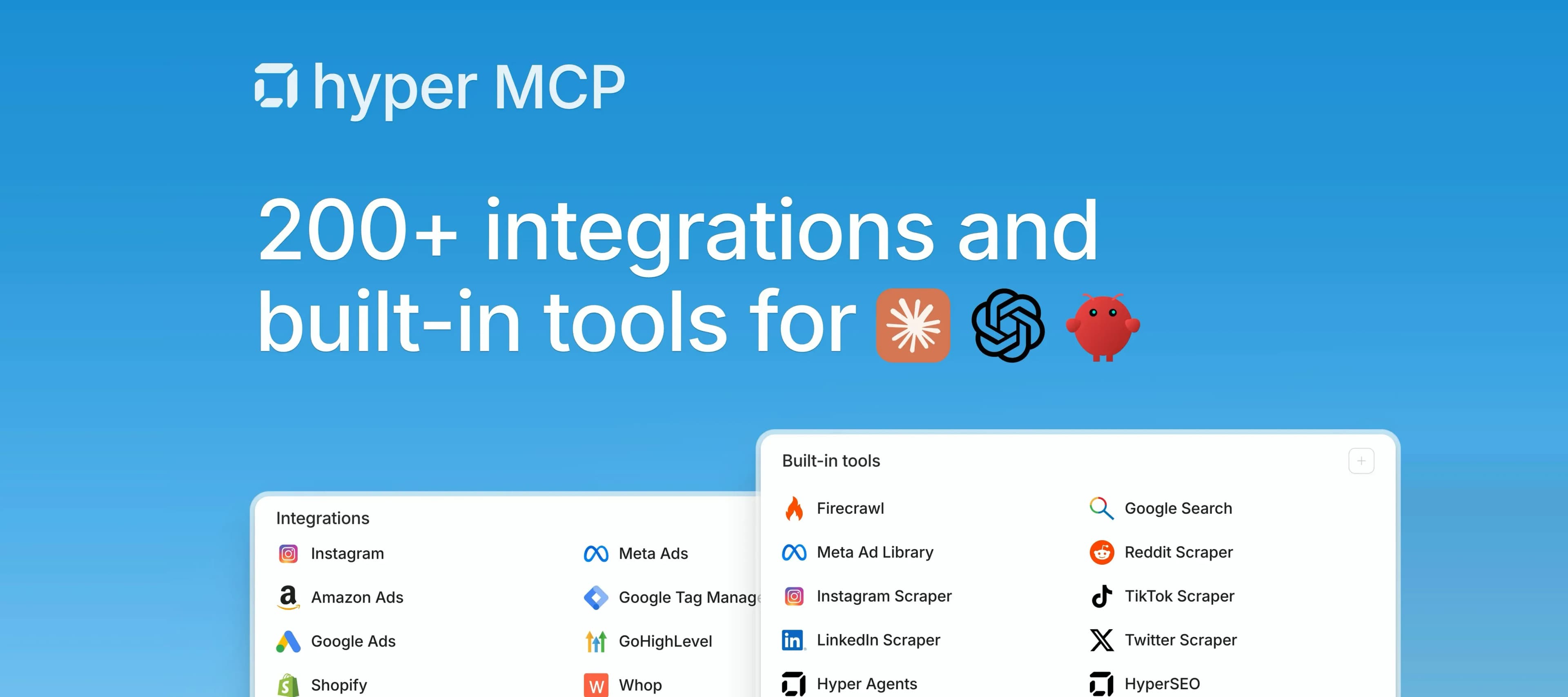


One MCP server. 200+ integrations. 40+ built-in tools. Every AI client.
Today we're releasing Hyper MCP: a single MCP server that brings Hyper's full platform. 200+ integrations, 40+ built-in tools, 100+ skills, and our entire agent execution layer. Into Claude, ChatGPT, Codex, OpenClaw, Hermes, Cursor, Manus, and every MCP-compatible AI chat, agent, and client on the market.
For the last year we've been building the execution layer for agentic marketing. Today we're putting it inside every AI tool our customers already use.
The agent-building problem
We've built a lot of agents, and we've watched a lot of people try to build them. The story always plays out the same way.
You get a prompt working and the reasoning is solid. The model can plan, decide, follow an instruction loop. Then you ask it to do the actual work: send an email, pull an ad report, scrape a competitor, post to a CMS. That's where it stops.
What follows is the part nobody writes blog posts about. Finding the right API docs, generating keys, debugging an OAuth flow you've seen a hundred times, wiring auth into your environment, testing the integration, and praying the schema hasn't shifted since the last example you saw. Do that across every tool an agent needs and half a day is gone before the agent has done anything real.
Context switching compounds the pain. Claude, Cursor, ChatGPT, Codex. Each with its own config, its own skills, its own prompt conventions. Every jump between them accumulates technical debt: expired auth, scripts built against a directory structure you've since changed, tools that half-work and don't tell you why.
Hyper MCP is our answer to both problems.
What Hyper MCP is
Hyper MCP is one MCP connection that gives your AI client of choice access to the entire Hyper platform. It's not a thin connector. It's the full surface area of what Hyper does. Exposed through a protocol every major AI client now supports.
You get:
- 200+ integrations. Gmail, Slack, HubSpot, Salesforce, Shopify, Stripe, Klaviyo, Attentive, Notion, Linear, Webflow, WordPress, Ghost, Beehiiv, GA4, Search Console, and more
- Ad platforms built for real media buying. Meta, Google, Amazon, TikTok, LinkedIn, and Pinterest, with deep campaign management, targeting, creative, and reporting
- 40+ built-in tools. scrapers for Reddit, Twitter, Instagram, TikTok, YouTube, and the Meta Ads Library; Firecrawl; HyperSEO; image and video generation; a sandbox; a database; a file system
- 100+ skills. reusable agent playbooks covering paid media, SEO, content, social, research, and more
- Hyper's full agent platform. memory, triggers, scheduling, approvals, and workflow execution
Setup takes under a minute. OAuth or an API key. Connect once to Claude, ChatGPT, or any other MCP-compatible client, and your agent gets the whole stack.
Ad platforms, built for actual execution
Most "integrations" stop at the surface. A couple of endpoints, basic read access, call it done. That approach breaks the moment an agent needs to do something real.
Our ad platform integrations are the deepest on the market. Meta Ads, Google Ads, Amazon Ads, TikTok Ads, LinkedIn Ads, Pinterest Ads. Full campaign CRUD, audience targeting, creative management, asset uploads, search-term reporting, and conversion tracking. We're an approved developer on Meta, Google, and the major platforms.
We built them by running them. Our own agents manage campaigns on these tools every day, which is why they handle edge cases generic connectors miss: budget guardrails that don't break during mid-campaign edits, flexible_spec targeting that actually works, Advantage+ setups that don't silently override your exclusions.
If you've ever watched a generic Meta connector fail on a multi-ad-set launch, you know the difference between having API access and having a good integration.
Built-in tools that nobody wants to set up
A lot of what an agent needs isn't an integration. It's a tool. Web scraping. Browser automation. A sandbox to run generated code. An image generator. A file system it can actually write to.
Hyper MCP ships all of it, native. No extra keys, no packages to install, no 11pm OAuth debugging.
Inside:
- Scrapers for Reddit, Twitter, Instagram, TikTok, LinkedIn, and YouTube
- Meta Ads Library scraper. Scrape any brand's live ads, import to a table in one call
- Firecrawl + web browsing + web scraper. Crawl or parse any site
- HyperSEO. Keyword research, AI search visibility, competitor analysis, historical rank data
- Image generation with GPT Image, Seedance, and other frontier models
- Seedance 2.0 video generation
- Sandbox. Run generated code in isolation
- Database + file system. Agents can actually persist and retrieve data
These are the tools every serious agent build needs, and almost no one ships all of them together.
200+ apps you already use
The tools are only half the story. The other half is the 200+ integrations that let your agent operate inside the systems your team already uses:
- Email and messaging. Gmail, Outlook, Slack, Microsoft Teams, Telegram
- CRM and marketing. HubSpot, Salesforce, Klaviyo, Attentive, Apollo
- Ecommerce and payments. Shopify, Stripe, Whop
- Productivity. Notion, Linear, Jira, GitHub, Google Sheets, Drive, Docs, Calendar
- Content and CMS. Webflow, WordPress, Ghost, Wix, Beehiiv
- Analytics and attribution. GA4, Google Search Console, Google Tag Manager
Each is one-click OAuth or an API-key paste. Each is maintained by us. And each works with every other tool in the stack, so your agent can pull a Meta Ads report, cross-reference conversions in GA4, draft a summary in Claude, post it in Slack, and log it in Linear. All in one run.
Skills. Reusable capabilities, built in
Hyper isn't just a tool surface. It's a full agent platform, and the MCP exposes all of it.
You get:
- 100+ skills, built in. reusable capabilities that empower agents to operate like experts across a domain. Voice DNA, content generation, CMO, ad creative, SEO + GEO, viral content, Meta ads SOP, client reporting, competitive research, and more. Each skill is a complete end-to-end workflow the agent reads before executing, so the moment your Claude or ChatGPT session connects to Hyper MCP, it behaves like a specialist in the relevant function.
- Memory. persistent context across sessions, so agents don't start from zero every time
- Triggers and scheduling. recurring tasks, cron schedules, event-based workflows
- Approvals and guardrails. every tool and action can require human approval before it runs
- Native agent management. create, configure, and schedule agents on Hyper from inside Claude or ChatGPT via MCP
Ask Claude to build you a marketing agent on Hyper and it will. Attach the right tools, load the right skills, wire up the right scheduled tasks. The agent then runs on Hyper natively, with the full platform behind it.
Security and control by default
One of the things we cared most about building this was making sure no tool, no agent, no connection runs without explicit permission.
Every tool and action in Hyper MCP can be customized, permissioned, and gated. You decide:
- Which tools the agent can use
- Which actions require human approval (delete a campaign, send an email, transfer funds)
- Which accounts and resources the agent can touch
- Exactly how each integration behaves when invoked
Agents only do what you let them. Full audit trail on every run. Approval gates on anything destructive.
Hyper MCP vs Hyper Agents
A question we get a lot: how does Hyper MCP relate to the agents you run natively on Hyper?
Hyper MCP brings Hyper into external AI clients. Use Claude, ChatGPT, Codex, OpenClaw, Hermes, Cursor, or Manus as your front end, and let Hyper handle the execution. Your tools and workflows live on Hyper, but the chat lives wherever you like.
Hyper Agents are the native experience. Hosted agents with built-in workflows, approvals, memory, scheduling, and a Hyper-optimized reasoning layer. For teams that want the full managed experience, this is home base.
Both use the same tools, the same skills, the same platform. You can build an agent in Claude via MCP, push it to Hyper, and run it on a schedule. You can also start in Hyper and call it from Claude when you want to work locally.
Who this is for
Hyper MCP is built for anyone who's tried to build a real AI agent and hit the integration wall.
- Marketers running paid ads, SEO, content, and lifecycle. Now your AI client can actually launch campaigns, pull reports, scrape competitors, and post content
- Founders and operators who want agents that ship work, not prototypes
- Agencies and consultants building client workflows across Meta, Google, GA4, and CRMs
- Developers wiring up custom agents in Claude Code, Cursor, or Codex who don't want to spend a week on API plumbing
If you've ever looked at an agent build and thought "the reasoning is easy, the integrations are killing me," this is for you.
Custom MCP support
Hyper MCP is extensible. You can connect Ahrefs, Similarweb, Posthog, Stripe, and your own internal MCP servers alongside Hyper's, all from the same connection. One server to your client, everything underneath.
What we're shipping next
This is the first release. We're already working on:
- Deeper attribution. unified conversion tracking across Meta, Google, TikTok, and GA4 through a single query surface
- More ad platforms. Reddit Ads, Snapchat, Microsoft Ads
- Video generation depth. longer formats, brand-consistent character generation, voiceover
- Partner-contributed skills. vertical playbooks for ecommerce, B2B, and agency workflows
- Multi-agent orchestration. agents that hand off work to each other across the platform
If there's an integration or a tool you want to see, tell us. Our roadmap is largely set by what our customers actually ask for.
Try it
Hyper MCP is live today. Setup takes under a minute.
Connect it → hyperfx.ai
Today, more than 1,000 marketing teams, founders, and operators run on Hyper. We're building the AI execution layer behind modern marketing. Through our platform, our MCP, and our APIs. Hyper MCP is the biggest step we've taken toward putting that layer inside every tool you already use.
The bottleneck in AI agents was never the model. It was integrations.
Now it's solved.