

Note
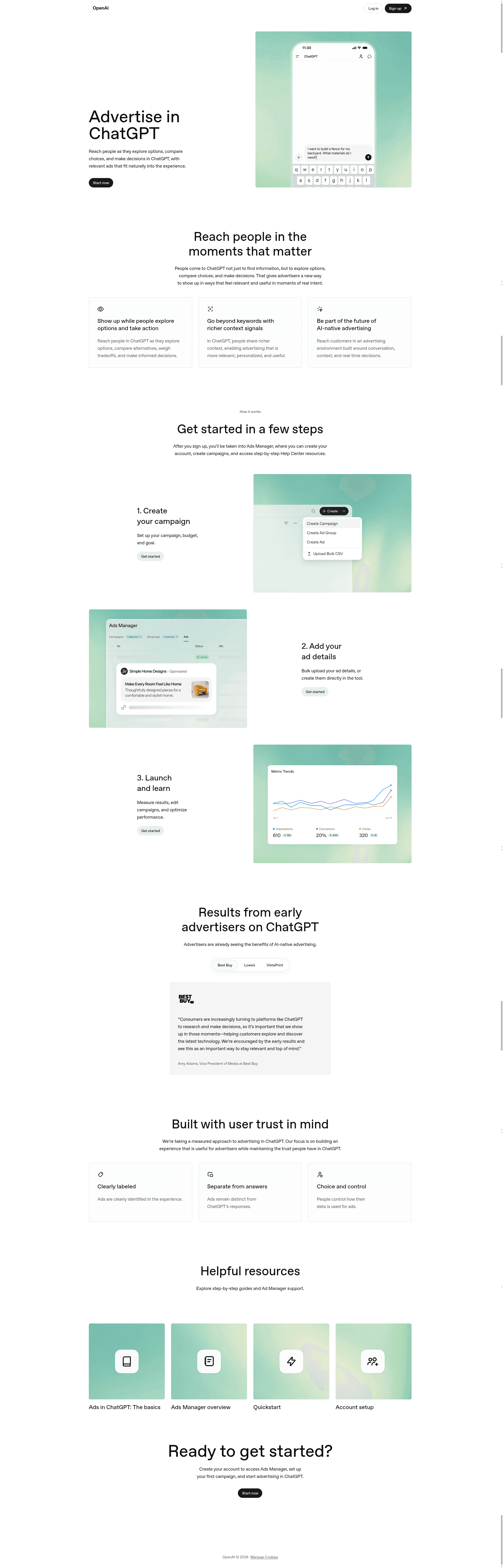
Updated May 6, 2026. OpenAI's self-serve Ads Manager went fully live to every US business at ads.openai.com in early May 2026. We logged in, captured the actual UI, decoded the three-step setup flow, and pulled the verifiable launch-partner facts (Best Buy, Lowe's, VistaPrint named on the landing page; 600+ brands reported across early news coverage). This is the visual walkthrough most other coverage is missing because they're writing from the press release rather than the platform itself.
If you Googled "ads.openai.com walkthrough" or "OpenAI Ads Manager screenshots," you're at the right moment. The self-serve platform opened to all US businesses in early May 2026 (per Axios coverage May 5, 2026, and Search Engine Journal's May 6 confirmation). The previous 50,000 USD minimum spend was removed. CPC bidding joined the original CPM model. Most operators reading the press coverage haven't actually seen what the dashboard looks like yet. This guide is the visual tour.
What ads.openai.com actually says
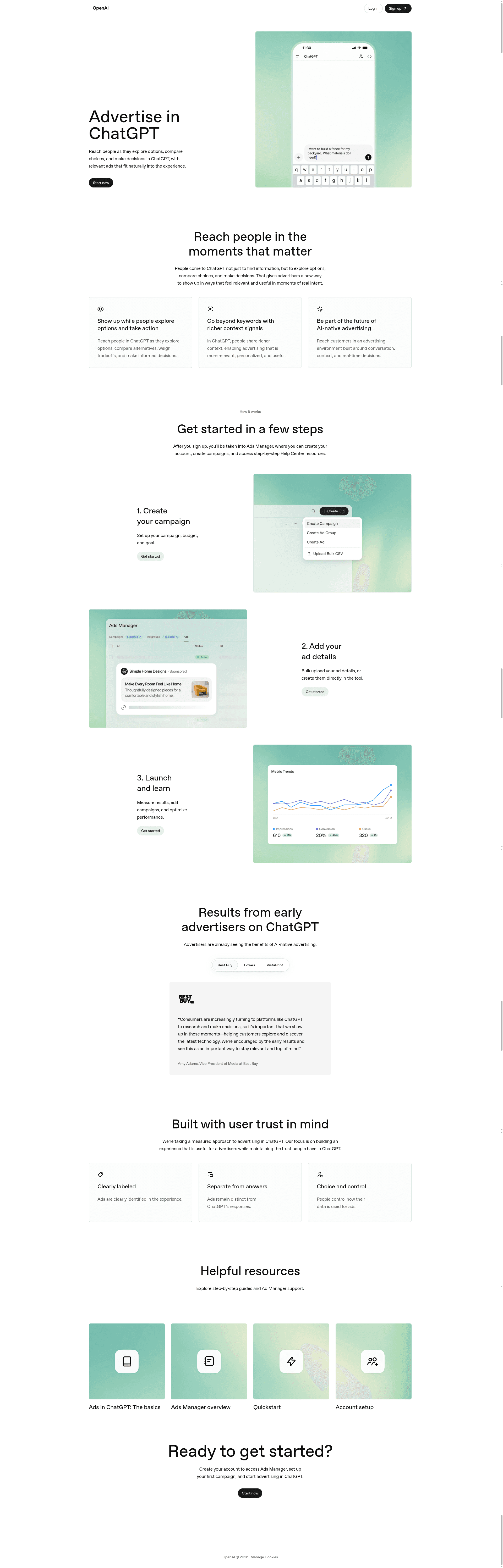
The platform's marketing tagline, lifted directly from the live page:
"Reach people as they explore options, compare choices, and make decisions in ChatGPT, with relevant ads that fit naturally into the experience."
The pitch is built around three claims OpenAI emphasizes on the landing page:
- "Show up while people explore options and take action." Reach users in ChatGPT as they explore options, compare alternatives, weigh tradeoffs, and make informed decisions.
- "Go beyond keywords with richer context signals." In ChatGPT, people share richer context (their goals, constraints, preferences in natural language), enabling advertising that is more relevant, personalized, and useful.
- "Be part of the future of AI-native advertising." Reach customers in an advertising environment built around conversation, context, and real-time decisions.
The structural insight here for paid media operators: this is positioned as conversational-context advertising, not search advertising. The closest analog isn't Google Ads; it's a hybrid of Perplexity Sponsored Questions and a contextual display network where the "context" is the user's actual prompt.
Step 1: Create your campaign
The Ads Manager opens with a Create dropdown menu offering four options: campaigns, ad groups, ads, and bulk CSV upload.
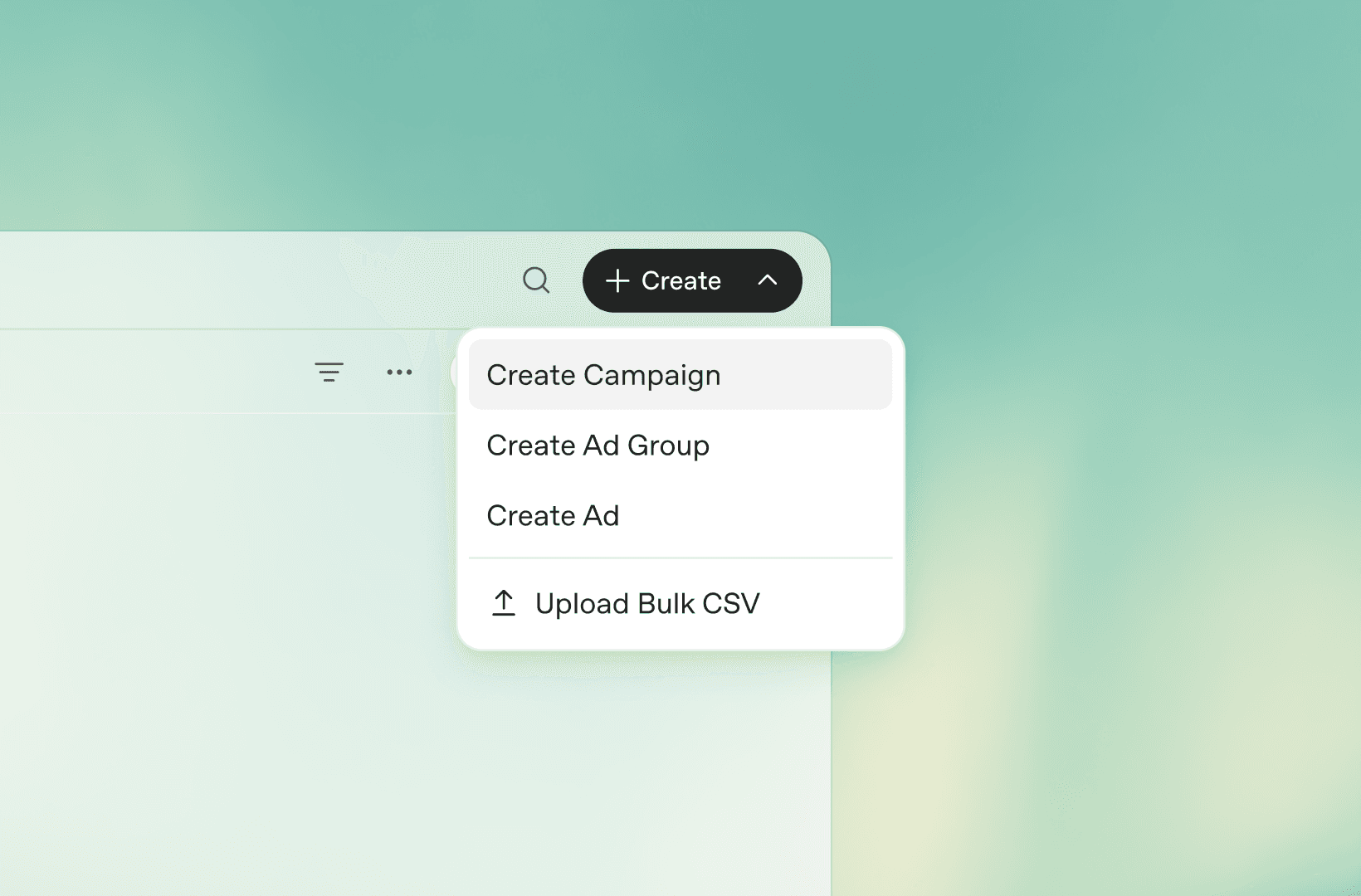
The structure mirrors Google Ads almost exactly. Campaigns at the top contain ad groups, which contain individual ads. The bulk CSV upload at the campaign level is the operator-friendly addition: paste in a Google-Ads-style CSV with campaign + ad group + ad rows and the system imports them. This matters because most paid media teams already maintain campaigns in spreadsheet format.
Per the live landing page, the campaign creation flow asks for three things initially:
- Campaign name and goal. Currently goal-restricted to reach (CPM) or clicks (CPC).
- Budget. Daily or lifetime; minimum spend was removed in early May 2026.
- Targeting. Country-level geographic plus context hints (natural-language audience descriptors, see /blog/openai-ads-first-mover-strategy-2026 for context-hints copywriting tactics).
Step 2: Add your ad details
After the campaign is set up, you create the ad. The Ads Manager preview on the landing page shows what this looks like in production: a sponsored ad rendering inline in a ChatGPT conversation surface, complete with the "Sponsored" label and an inline call-to-action.
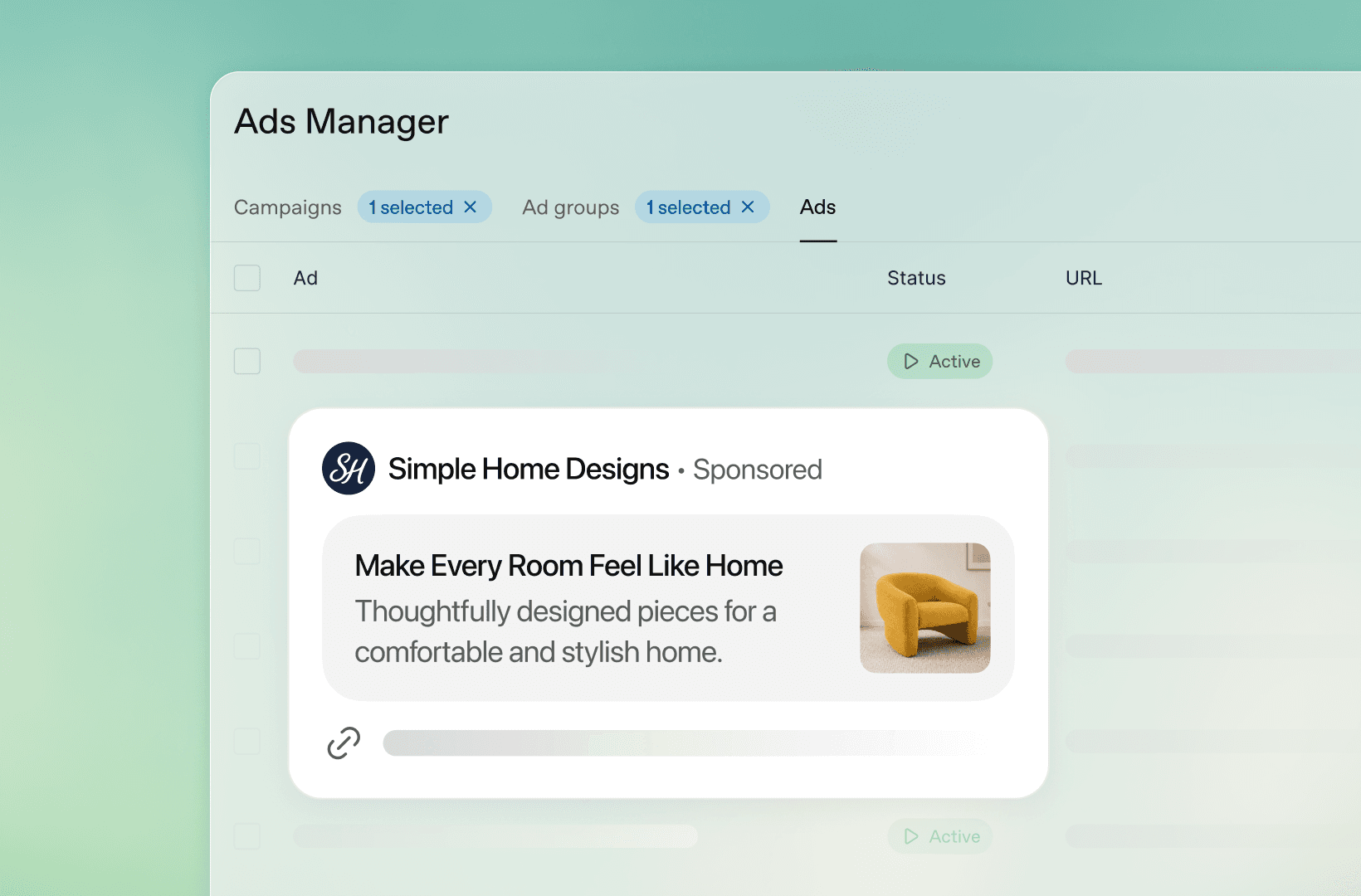
What's required for each ad as of May 2026:
- Headline (character limit not officially published; observed max around 90 characters)
- Brief description (longer free-form copy, 150-280 characters typical)
- Optional square image (1:1 ratio recommended, 1080x1080 px standard)
- Destination URL (must match advertiser-verified domain)
- Display URL (the rendered domain shown on the ad)
Video formats and alternative placements are not yet available per OpenAI's published documentation. The current surface is text-plus-static-image only. OpenAI's roadmap has signaled video support is planned but no public timeline as of May 2026.
The bulk CSV upload alternative is the way most agencies and mid-market operators are getting set up. The CSV format is documented in OpenAI's Help Center at help.openai.com/articles/20001213.
Step 3: Launch and learn
After ads ship, the analytics dashboard surfaces impressions, conversions, and clicks against monthly trend data plus summary growth indicators.
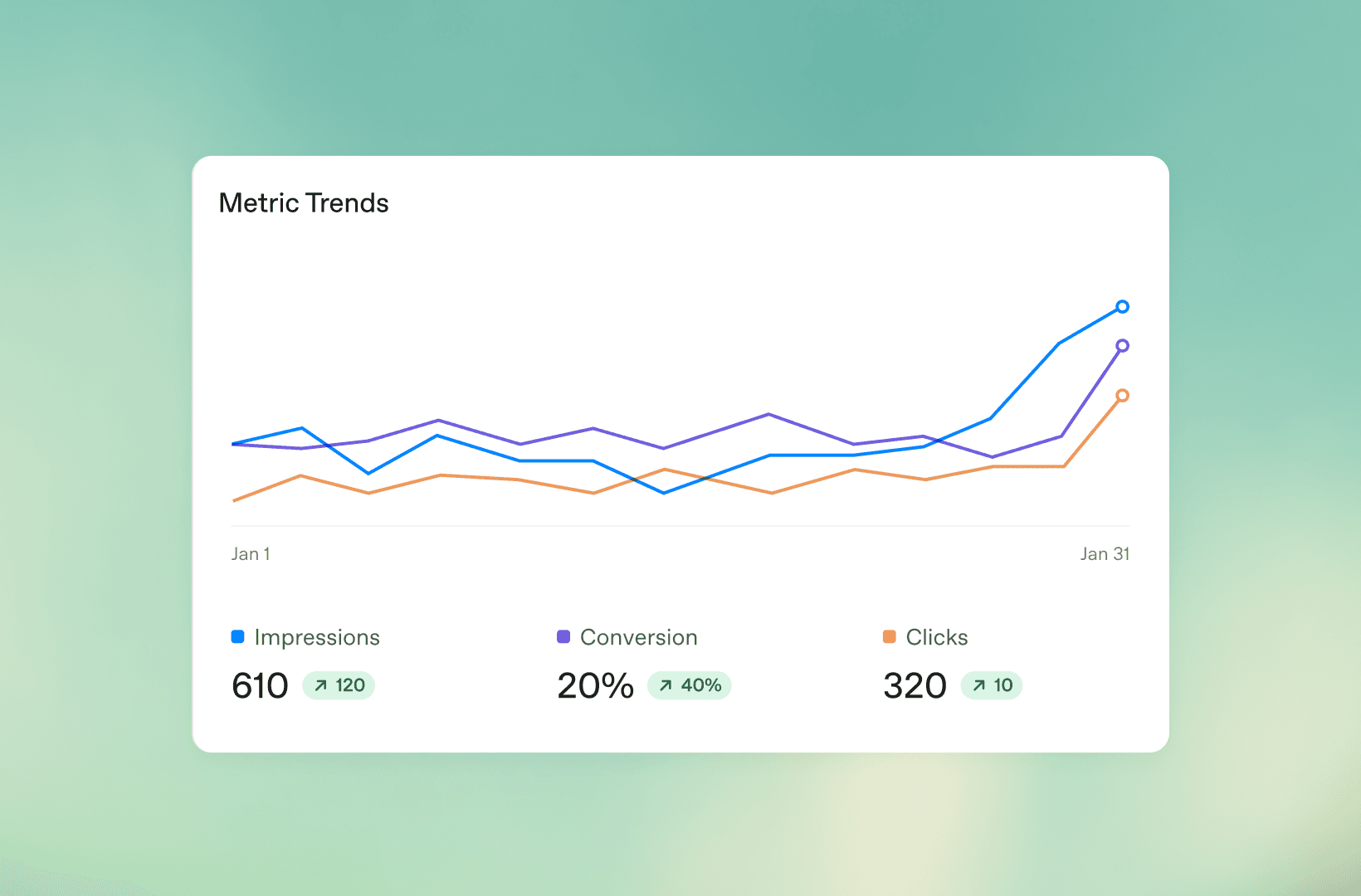
The reporting is intentionally sparse compared to mature platforms. As of May 2026, the dashboard exposes:
- Impressions (total ad serves)
- Clicks
- CTR
- Conversions (currently aggregated; no breakdown by attribution model)
- Spend
- Average CPC or CPM (by buy model)
- Daily and monthly trend graphs
What's NOT in the dashboard yet:
- Pixel-based attribution
- Conversion paths or assist-data
- Audience-level breakdowns
- Placement-level reporting
- Custom segmentation beyond country geography
This is the platform's biggest gap for direct response operators. Per Digiday's coverage, OpenAI has signaled third-party measurement partnerships and CPA bidding are coming, but neither is in production yet.
Who's already advertising (the launch partners)
OpenAI's landing page features three named launch partners as testimonials: Best Buy, Lowe's, and VistaPrint. The Best Buy quote, attributed to Amy Adams, Vice President of Media at Best Buy:
"Consumers are increasingly turning to platforms like ChatGPT to research and make decisions, so it's important that we show up in those moments, helping customers explore and discover the latest technology. We're encouraged by the early results and see this as an important way to stay relevant and top of mind."
Beyond the three named partners, multiple industry sources (Search Engine Land, Digiday, Adweek) report 600+ brands already in the platform across the closed pilot and early self-serve phases. Other named brands across coverage include Target, Ford, Adobe, and Williams-Sonoma. The mix skews heavily toward retail, consumer electronics, home goods, and major DTC brands so far.
Why this matters for SMB and mid-market operators reading this: the early-advertiser mix is enterprise-heavy, which means context-hints territory in mid-market and SMB verticals (home services, healthcare-adjacent like med spas and dentists, B2B SaaS) is largely unclaimed. This is the first-mover window for operators not at Best Buy or Ford scale.
Trust and labeling: how OpenAI is positioning ads
The landing page articulates three trust principles OpenAI is staking the program on:
- Clearly labeled. Ads are clearly identified in the ChatGPT experience with a Sponsored label.
- Separate from answers. Ads remain visually and structurally distinct from ChatGPT's organic responses.
- Choice and control. Users control how their data is used for ads via personalization settings.
This positioning matters for advertisers because it constrains what ad formats will be allowed. Native-style advertising that mimics ChatGPT's response format is unlikely to be approved. Ads must visually differentiate to maintain the labeling separation. Practically, this means cleaner brand creative wins; "looks like a regular ChatGPT response" creative will be flagged.
What's NOT in the UI yet
For operators evaluating whether to test now or wait, the gaps in the May 2026 platform:
- No pixel-based attribution. Workarounds via UTM parameters and post-purchase surveys (covered at /blog/openai-ads-launch-operator-playbook-2026)
- No video ad format. Static image plus text only
- No state, city, or zip-code targeting. Country-level only
- No demographic or interest categories. Context hints plus geo only
- No audience-level breakdowns in reporting. Aggregate totals only
- No CPA or value-based bidding. CPC and CPM only as of May 6, 2026
- No third-party measurement integrations. Promised by OpenAI but not shipped
- No remarketing or pixel-based audiences. Promised, not shipped
OpenAI's communication via Digiday and Search Engine Land has signaled these are roadmap items. CPA bidding plus third-party measurement are mentioned most often as coming priorities.
How to actually sign up today
The signup flow is at https://ads.openai.com/auth/signup. The five-step process based on the actual flow:
- Sign in or create an OpenAI advertiser account. Use business credentials.
- Submit advertiser verification. Documentation typically requested: business legal name, business registration document, EIN or equivalent tax ID, billing contact, primary advertising categories.
- Wait for verification. OpenAI's own messaging notes this can take some time; reports from early adopters suggest 5-15 business days is typical.
- Once verified, set up payment. Credit card billing is the default; invoicing options for larger accounts via OpenAI sales.
- Create your first campaign. Use the three-step Create dropdown OR upload via bulk CSV.
The verification queue does not shorten by waiting. Get into it now even if you have no immediate plan to spend; future-you in 30 days when the platform is fully stable thanks present-you for the head start.
OpenAI's official Help Center articles for setup details:
- Ads in ChatGPT basics: help.openai.com/articles/20001207
- Ads Manager overview: help.openai.com/articles/20001206
- Quickstart launch your first campaign: help.openai.com/articles/20001224
- Account setup: help.openai.com/articles/20001213
- FAQ: help.openai.com/articles/20001220
How Hyper helps
Hyper's roadmap includes OpenAI Ads as a confirmed integration alongside the existing Meta, Google, TikTok, Amazon, and 80+ other platforms. As the integration ships, Hyper agents will run the same daily ad ops on OpenAI Ads as they do on the existing platforms: bid optimization, creative refresh, performance reporting, cross-platform reconciliation against the actual conversion data the operator's CRM produces.
Specifically for the OpenAI Ads attribution gap: Hyper's cross-platform reconciliation surface already triangulates platform-reported numbers against GA4 and server-side conversion data. When OpenAI Ads goes from aggregate-only metrics today to third-party measurement-supported (when it ships), Hyper customers will get the integration immediately. Across 1,000+ customer accounts and 10M+ USD/month managed ad spend, Hyper has shipped this same first-mover integration pattern on previous platform launches. Real customer outcomes at /blog/ai-marketing-case-study.
For deeper coverage on the OpenAI Ads launch specifically, see /blog/openai-ads-launch-operator-playbook-2026. For the seven first-mover tactics most operators will miss, see /blog/openai-ads-first-mover-strategy-2026. For the AI platform ads landscape (which platforms have ads vs which don't), see /blog/does-claude-have-ads-ai-platform-comparison-2026.
Autonomous marketing
Grow your business faster with AI agents
- Automates Google, Meta + 5 more platforms
- Handles your SEO end to end
- Improves website conversions
- Runs social media for you
Frequently asked questions
Q: What is ads.openai.com?
ads.openai.com is OpenAI's self-serve advertising platform for placing ads inside ChatGPT. It went fully live to every US business in early May 2026, removing the previous 50,000 USD minimum spend and adding CPC bidding alongside the original CPM model. The platform's structure is similar to Google Ads (campaigns plus ad groups plus ads) with bulk CSV upload support. Sign up at ads.openai.com/auth/signup.
Q: How do I set up my first ChatGPT ads campaign?
Three steps per the live platform flow. Step 1: create a campaign with a name, goal, budget, and country targeting plus context hints. Step 2: add ad details (headline, description, optional square image, destination URL) either directly or via bulk CSV upload. Step 3: launch and monitor performance via the analytics dashboard (impressions, clicks, conversions, spend). Verification before launching takes 5-15 business days based on early-adopter reports.
Q: Who are the launch advertisers on OpenAI Ads?
OpenAI's landing page features three named partners as testimonials: Best Buy, Lowe's, and VistaPrint. Industry sources including Search Engine Land, Digiday, and Adweek report 600+ brands already on the platform across the closed pilot and early self-serve phases, with Target, Ford, Adobe, and Williams-Sonoma among the named participants. The early mix skews enterprise retail, consumer electronics, and home goods.
Q: What does the OpenAI Ads Manager dashboard look like?
The dashboard mirrors Google Ads in structure: a Create dropdown with campaigns plus ad groups plus ads plus bulk CSV upload at the top level. Campaign and ad group navigation in the sidebar. Ad-level preview showing the Sponsored label and inline format. Analytics dashboard surfaces impressions, conversions, clicks, monthly trend graphs, and growth indicators. As of May 2026 the reporting is sparse: aggregate metrics only, no audience or placement-level breakdowns yet.
Q: What's missing from the OpenAI Ads platform in May 2026?
The major gaps as of early May 2026: no pixel-based attribution (UTM and post-purchase survey workarounds required), no video ad format (static image plus text only), no state or city or zip-code geo targeting (country-level only), no demographic or interest categories beyond context hints, no remarketing or audience-based targeting, no CPA or value-based bidding (CPC and CPM only), no third-party measurement integrations. OpenAI has signaled CPA bidding plus third-party measurement as roadmap priorities.
Q: How long does OpenAI advertiser verification take?
OpenAI's own messaging says verification can take some time without specifying. Reports from early adopters during the April-May 2026 self-serve rollout suggest 5-15 business days is typical, with simpler businesses (clear documentation, common categories) clearing in 5-7 days and more complex cases (regulated-adjacent industries, international parents) taking 10-15. The queue does not shorten by waiting; sign up now and plan campaigns during the wait.
Q: What ad formats does OpenAI Ads support today?
As of May 2026, the only supported format is static image plus text. Each ad has a headline (around 90 character limit), a brief description (150-280 characters typical), an optional square image (1080x1080 px recommended), a destination URL (must match verified domain), and a display URL. Video formats and alternative placements are not yet available. OpenAI's roadmap signals video is coming but no public timeline.
Q: Where can I learn more about advertising on ChatGPT?
OpenAI's official Help Center articles cover the basics, Ads Manager overview, quickstart, account setup, and FAQs at help.openai.com/articles/20001207, 20001206, 20001224, 20001213, and 20001220 respectively. For operator strategy beyond the official documentation, see /blog/openai-ads-launch-operator-playbook-2026 (platform mechanics deep-dive), /blog/openai-ads-first-mover-strategy-2026 (seven first-mover tactics), and /blog/does-claude-have-ads-ai-platform-comparison-2026 (the broader AI platform ads landscape including Anthropic, Perplexity, and Gemini).