


The foundation of Hyper is general intelligence - autonomous agents that connect to your tools, complete tasks and deliver results. Unlike traditional AI tools that simply answer questions, Hyper takes action - sending emails, running deep research, analyzing data, building websites, and beyond. It's truly limitless. With instant actions on demand in chat, you can work with and delegate tasks to Hyper just like you would a teammate.
Hyper is a full stack AI platform and operating environment for agents. You can spin up ambient agents and workflows directly from a prompt in chat. Agents operate in sandbox environments with real compute, connect to your data, and run 24/7 with persistent memory. Workflows can contain multiple steps. programatic tool calls with conditional logic, like traditional automations in Zapier or Make, or fully agentic, with autonomous agents that have access to the tools, instructions, and data they need to operate like experts in any domain and complete their task. Both agents and workflows can do essentially anything you need. The distinction is in how you want the work to run.
That's the foundation. On top of it, we built the context layer that turns Hyper into a marketing expert. The decision frameworks, operational knowledge, and specialized tooling that let agents operate like someone who's spent years running campaigns across every channel.
The problem with general agents
When you connect an LLM to Meta's Marketing API. Whether it's a direct connection or via an MCP. It can do a few things. It's pretty good at pulling data and running basic analysis. But without the right approach or skills, it doesn't know what to look for or how to interpret what it finds.
Campaign creation is where things really fall apart. The agent doesn't know which campaign type fits your goal, how to structure targeting so audiences don't overlap, or which settings look harmless but quietly tank performance. It gets partway through the work, then either hits a dead end or starts making mistakes you won't necessarily catch until it's too late.
The underlying issue is complexity. Meta Ads Manager alone has dozens of objectives, hundreds of targeting combinations, and budget strategies that interact in non-obvious ways. Google Ads is just as dense. TikTok, LinkedIn, Pinterest. Each platform operates according to its own logic, and all of them change constantly as new features roll out and algorithms shift.
Having API access to these platforms isn't the same as understanding them.
The environment principle
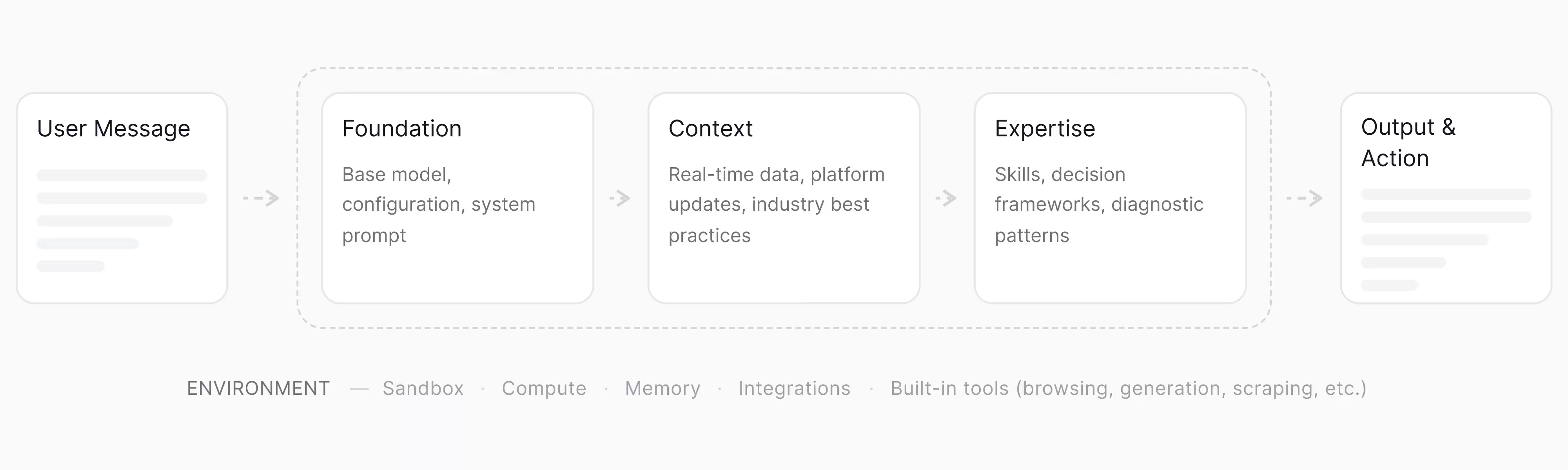
Knowledge and understanding, especially with the latest best practices and information, don't come out of the box. Intelligence comes from giving a model access to the right tools, data, memory, and execution context. The environment shapes what an agent can actually accomplish. Manus is a perfect example. They achieved the highest scores on the GAIA (General AI Assistance Benchmark) leaderboards across all three difficulty levels, outperforming competitors like OpenAI's Deep Research Agent, while running on Anthropic's models. They didn't build a better model; they built a better environment for the model to operate in.
A world-class chef in a professional kitchen with every tool and ingredient exactly where they need it. Put that same chef in front of a campfire with a single pan, and the output is completely different. The skill didn't disappear. The environment limited what was possible.
Hyper works within a complete sandbox environment. A virtual computer with internet access, a persistent file system, persistent memory, 80+ integrations and counting, and the ability to install software and create custom tools. This means Hyper can work independently, remember context across long tasks, tackle complex work, and deliver production-ready results without you having to manage every detail.
For marketing, we applied this principle directly. Rather than just connecting to platforms, we built in the knowledge that makes someone effective at using them. The decision frameworks, the diagnostic patterns, the operational knowledge that experienced marketers rely on. Within the sandbox, Agents can write Python, run SQL against data warehouses, and build the kind of analysis that normally requires a data team. Computational power for marketing work, not just API calls.
It meant bringing together years of building AI systems with the cumulative experience of marketers who've run campaigns across every channel. Figuring out what decisions matter, what context agents need, how platforms actually behave versus how their documentation says they behave.
The context layer
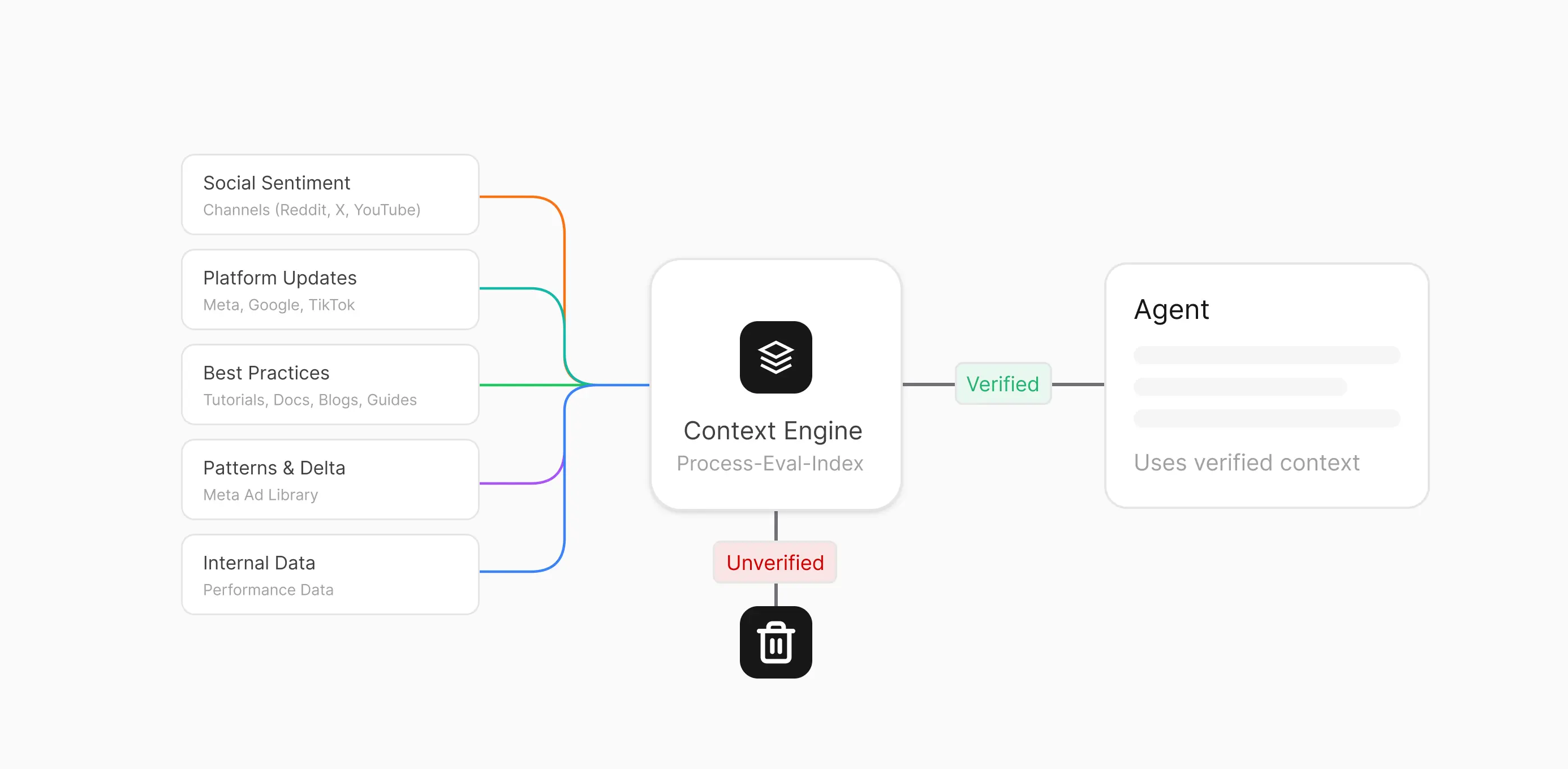
For every major ad platform, we built specialized tooling and skills that include these decision frameworks. When Hyper analyzes a campaign, it doesn't just pull metrics. It runs the same diagnostic logic an expert would, checking whether low performance stems from the ad creative or the landing page, identifying when rising costs correlate with frequency fatigue, catching configuration issues before they compound.
Because marketing changes quickly, we built pipelines that keep this context current. Capturing platform updates, algorithm changes, and shifting best practices so agents always operate with live knowledge rather than stale documentation. Meta's Andromeda is a perfect example: a fundamental shift in how their ad delivery system works, changing budget allocation, audience targeting, and optimization strategies almost overnight. Context needs to be dynamic. Based on what's happening today, this week, this month, this quarter, and how those time periods compare to each other. Capturing the delta, surfacing patterns, and honestly just seeing what everyone else is saying and what their experience is.
Paid media is a compelling example because the complexity is so visible, but the same principles apply across paid, owned, and earned. With integrations across all major ad platforms, Google Search Console, GA4, email ESPs, and CRMs, Hyper can run these strategies in tandem. Supporting organic search with content marketing, building systems that scale.
Think of this as 360 visibility and execution. Hyper isn't just running your ads; it's thinking about your marketing as a system that compounds results. Audit your funnel, surface trends, automate content pipelines and operations. Whether it's ranking first on Google, retargeting on Meta, or turning earned media into leads, Hyper brings every piece together to work in sync. All you have to do is send a message.
Hyper is transparent. It's not a black box agency. Hyper shows you what's working and why. You can just ask it in chat. Plus, you can set up automated email updates at any frequency with high-level reports, real-time dashboards, and clear visibility. A partnership built on accountability and results.
Built-in tools and data
Beyond the context layer, we built capabilities directly into Hyper that make agents truly powerful.
HyperSEO provides search visibility tracking across Google alongside LLM visibility across ChatGPT, Claude, Perplexity, and Gemini. When someone asks an AI for recommendations in your category, you can see whether your brand appears in the response. Platforms like Semrush and Ahrefs are expensive. Easily into the thousands if you add on all their features. We built this in. It's available to any user, and using it is as simple as sending a message.
Beyond HyperSEO and the sandbox capabilities we mentioned, Hyper can scrape content from anywhere. The web, Meta's Ads Library, Reddit, X, YouTube. It can generate images and video using the latest frontier models. It can browse the web autonomously, log into platforms with securely stored credentials, and navigate complex workflows that would normally require a human at the keyboard. These are just a few examples of what's built in.
Operations beyond campaigns
The foundation of Hyper as an autonomous AI agent matters because so much of marketing. And any business. Is operations. Content compliance across teams, partners, and agencies, account management, the coordination that happens across email, Slack, and a dozen other tools. The list goes on.
Hyper can handle this. An agent can manage content compliance and approval workflows, flag content that historically gets rejected, learn from patterns, and route work to the right people. There's a reason finance companies are adopting AI agents for compliance. Agents are better at this than humans. They don't miss edge cases, they don't get tired, they apply rules consistently at scale.
This isn't about replacing people. It's the complete opposite. We believe the next decade will be won by individuals and teams that operate with the reach and efficiency of entire organizations. Our goal is for Hyper to be that tool for as many people as possible: a command center where AI empowers people to go beyond what they previously had the time or capacity to do, or simply frees them to focus on more important work. A workflow can pull performance data from every platform on a schedule and deliver reports automatically. You can create agents with assigned tasks that run on any frequency you need.
A common misconception is that your competition is AI. This isn't the case. Your competition is your competitors using AI. So whether you choose to go all in via Hyper or another platform, that decision is up to you. Either way, we urge you to make the leap.
The result
Hyper launches campaigns across all major ad platforms with the context to do it correctly, runs cross-platform analysis that would normally take hours, automates blog posts and content pipelines, handles SEO and organic search, and manages the operations that keep everything moving.
You can use Hyper for anything. For marketing, we built the depth that makes the difference between capability and expertise.
Launch and optimize ad campaigns with AI marketing agents.
Learn more at hyperfx.ai.